Best Solar Company

India's Solar Revolution 2.0: How Mega Projects, Domestic Manufacturing, and Rising Demand Are Reshaping the Market
Discover how India's gigawatt-scale solar projects, domestic manufacturing growth, and rising demand are reshaping solar prices and creating a new era for homeowners, businesses, and investors.
6/11/20264 min read
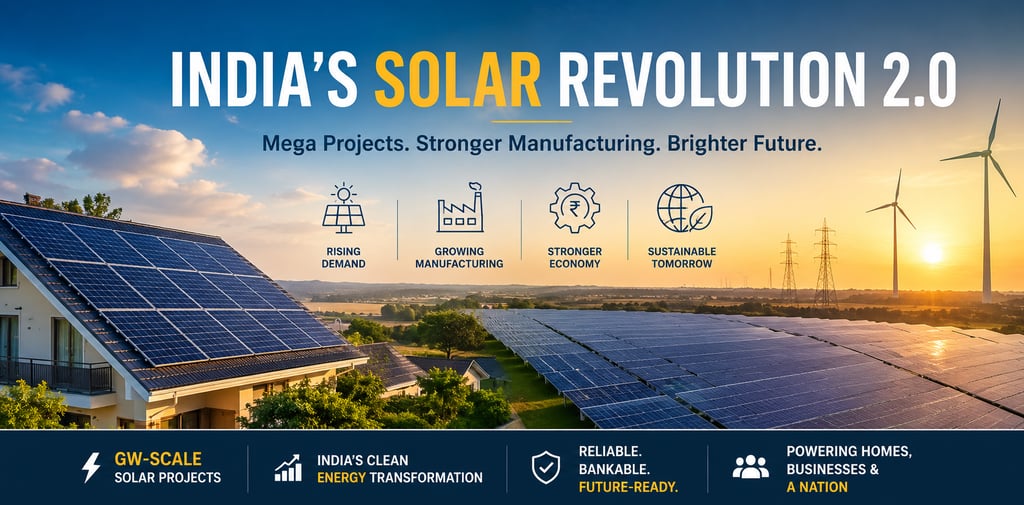

For years, solar energy in India was a simple conversation.
Solar panel prices were falling, technology was improving, and more homeowners and businesses were choosing to generate their own electricity.
Today, that conversation has changed.
Across the country, a new chapter is unfolding—one that is larger than rooftop solar, larger than electricity bills, and larger than individual projects.
India is building one of the world's largest renewable energy ecosystems.
And the decisions being made today by manufacturers, developers, investors, and policymakers will shape the solar industry for decades to come.
For consumers, this raises an important question:
What is really happening in India's solar market, and what does it mean for anyone planning to install solar?
The Solar Market Is No Longer Measured in Megawatts
Most homeowners think of solar in terms of a 3 kW, 5 kW, or 10 kW rooftop system.
Businesses may think in terms of 100 kW or 1 MW installations.
But India's solar industry has entered a completely different league.
The country's largest developers are now planning and building projects measured in gigawatts.
To put that into perspective:
A typical home installs 3–10 kW.
A commercial building may install 100 kW–5 MW.
Utility-scale developers are building projects of hundreds or even thousands of megawatts.
A single 1 GW solar park can require as many solar modules as more than 250,000 residential rooftop systems.
Now imagine multiple gigawatt-scale projects being developed simultaneously across the country.
The scale is extraordinary.
The Race to Build India's Renewable Future
Some of India's largest energy companies are investing billions of rupees into renewable energy infrastructure.
Companies such as Adani Green Energy, NTPC Green Energy, Tata Power Renewable Energy and ReNew Energy Global are participating in some of the largest renewable energy developments ever seen in the country.
These projects require:
Millions of solar modules
Massive quantities of steel structures
Kilometers of electrical cable
Large-scale substations
Energy storage systems
Highly skilled engineering teams
As these projects expand, demand for quality solar equipment continues to increase across the entire supply chain.
Why Solar Panel Prices Are No Longer Falling Like Before
Many customers still expect solar prices to decline every year.
That expectation was reasonable in the past.
However, today's market dynamics are very different.
India is no longer focused only on installing solar capacity.
The country is also strengthening domestic manufacturing capabilities.
This includes investments in:
Solar module manufacturing
Solar cell manufacturing
Supply chain development
Research and development
Advanced production technologies
Building a strong manufacturing ecosystem requires significant investment.
While this strengthens the industry in the long term, it can also influence equipment pricing in the short term.
As a result, the era of continuously falling solar prices may not continue in the same way many people expect.
A Shift From Cheapest to Strongest
One of the biggest changes happening in the solar industry is a shift in mindset.
A few years ago, many buyers focused almost entirely on price.
Today, developers investing hundreds or thousands of crores are asking different questions:
Will the modules perform reliably for decades?
Is the manufacturer financially strong?
Will warranty support be available in the future?
Can supply be maintained for large projects?
Is the technology bankable for long-term financing?
For a developer building a multi-gigawatt project, reliability matters far more than saving a few paise per watt.
This focus on quality is gradually influencing the entire market.
The Rise of Domestic Manufacturing
India's solar industry is witnessing unprecedented investment in manufacturing.
New factories are being established.
Existing facilities are expanding.
Advanced technologies are being introduced.
The long-term objective is clear:
Create a stronger and more self-reliant solar ecosystem capable of serving both domestic demand and international markets.
A robust manufacturing base can offer several advantages:
Greater supply stability
Better quality control
Faster product availability
Improved warranty support
Job creation and economic growth
Increased global competitiveness
This transformation may take time, but it has the potential to redefine India's position in the global solar industry.
What Does This Mean for Homeowners and Businesses?
For anyone considering solar today, there are three important realities.
1. Waiting May Not Deliver Lower Prices
Many customers postpone solar installations believing prices will drop significantly in the future.
However, rising demand, large-scale projects, manufacturing investments, and evolving market conditions mean future prices may not necessarily be lower.
At the same time, every month of delay means another month of electricity expenses.
2. Quality Matters More Than Ever
A solar system is expected to operate for 25–30 years.
When viewed over that period, the difference between a high-quality system and a low-cost system can be substantial.
The right engineering, components, and installation practices often create far greater value than a small upfront saving.
3. Solar Remains One of the Strongest Long-Term Investments
Despite recent market changes, solar continues to offer:
Reduced electricity bills
Protection against future tariff increases
Improved energy independence
Attractive long-term returns
Increased property value
For many homeowners and businesses, the economics remain highly compelling.
The Companies That Will Win the Next Decade
The next phase of India's solar growth is unlikely to be led by companies competing solely on the lowest price.
The market is increasingly rewarding companies that can deliver:
Strong engineering expertise
Reliable products
Professional project execution
Long-term service support
Customer trust
As customers become more informed, the focus is shifting from simply buying solar to investing in a system that performs reliably for decades.
Looking Beyond the Price Tag
When people discuss solar, the conversation often revolves around one question:
"How much does it cost?"
A more important question may be:
"What will electricity cost over the next 25 years?"
Electricity tariffs continue to rise.
Energy demand continues to grow.
Meanwhile, solar technology remains one of the most proven and accessible ways to control long-term energy costs.
The real transformation happening in India is not just about installing more solar panels.
It is about building an energy ecosystem capable of powering the country's future.
Final Thoughts
India's solar industry is entering a new era.
Gigawatt-scale projects are expanding across the country.
Manufacturing capacity is growing rapidly.
Investment is flowing into the sector at unprecedented levels.
And millions of consumers are becoming active participants in the renewable energy transition.
From a small rooftop installation in Ahmedabad to one of the country's largest solar parks, every solar system is now part of a much larger story.
A story of energy independence.
A story of industrial growth.
A story of long-term sustainability.
And perhaps most importantly, a story that is only just beginning.
The question is no longer whether solar will play a major role in India's future.
The question is whether we choose to be early participants—or late observers—of one of the largest energy transformations in history.
All Rights Reserved by Celestra Solar Pvt Ltd ©2023
CELESTRA SOLAR PVT LTD
Follow us


Catalogs
Useful Links